Friday, July 9, 2010

Old News: Wiki-hooliganism strikes Seton Hall Law School.

This is old news, but it's still funny.  I'm sure this story was blogged about to death when it was fresh, but I'm linking to it anyway for those who missed it and who didn't see Hardknock's post at BIDER.

Blog hooligan "Scaddenfarts" dropped a big stinker on the Wikipedia entry for Seton Hall Law School.  Referring to the Dean:

"The man takes more liberty with salary statistics than Michael Jackson did with 4 year olds at a Chuck-E-Cheese playpen."
"Scaddenfarts" or a group of people engaged in an edit war that went on for three months from May 6 through August 9 of 2009 until the Wikipolice finally corralled him/them.  (See the edit history for May-August 2009.)

Imagine what would happen if a group of thirty blog hooligans versed in Wikipedia Edit-ese descended upon an unsuspecting TTT's entry and engaged in a prolonged edit war, citing Wikipedia rules and arguing with shills on the entry's discussion page.

Monday, July 5, 2010

40 Years of Lawyer Overproduction, a Data Table, and 2 Charts

In my last two posts I explored the rate of new lawyer production in terms of the inverse number of attorneys per capita that could be sustained by graduation rates (expressed in terms of one lawyer for every X-amount of people) using the assumption that a new lawyer would want to practice for 40 years.  Let's call this number the Sustained Inverse Lawyers Per Capita, or SILPC.

I was curious about the historical trend, so I conducted a study and was surprised to discover that the law schools have been overproducing lawyers for almost 40 years!  In other words, the rate of production in terms of SLPC has averaged one lawyer for every 171.9 people since 1973.  I knew that lawyer overproduction had been a problem for decades, but I had never imagined that it was this bad!  I had previously assumed that the SILPC had decreased steadily over time, but apparently this is not the case.

I calculated this data using U.S. Census Data for the U.S. population and ABA statistics for the number of JDs awarded each year since 1963.

Assuming that, on average, a lawyer would want to practice for 40 years, SILPC = Population / (JDs Awarded * 40)

Year JDs Awarded US Population Inverse Lawyers Per Capita (SILPC)
1963 9,638 189,242,000 490.9
1964 10,491 191,889,000 457.3
1965 11,507 194,303,000 422.1
1966 13,115 196,560,000 374.7
1967 14,738 198,712,000 337.1
1968 16,007 200,706,000 313.5
1969 16,733 202,677,000 302.8
1970 17,477 205,052,000 293.3
1971 17,006 207,661,000 305.3
1972 22,342 209,896,000 234.9
1973 27,756 211,909,000 190.9
1974 28,729 213,854,000 186.1
1975 29,961 215,973,000 180.2
1976 32,597 218,035,000 167.2
1977 33,640 220,239,000 163.7
1978 33,317 222,585,000 167.0
1979 34,590 225,055,000 162.7
1980 35,059 227,726,000 162.4
1981 35,604 229,966,000 161.5
1982 34,847 232,188,000 166.6
1983 36,390 234,307,000 161.0
1984 36,688 236,348,000 161.1
1985 36,830 238,466,000 161.9
1986 36,122 240,651,000 166.6
1987 35,479 242,804,000 171.1
1988 35,702 245,021,000 171.6
1989 35,521 247,342,000 174.1
1990 36,386 250,132,000 171.9
1991 38,801 253,493,000 163.3
1992 39,082 256,894,000 164.3
1993 39,915 260,255,000 163.0
1994 39,711 263,436,000 165.8
1995 39,355 266,557,000 169.3
1996 39,921 269,667,000 168.9
1997 41,115 272,912,000 165.9
1998 39,456 276,115,000 175.0
1999 39,072 279,295,000 178.7
2000 38,158 282,434,000 185.0
2001 37,910 285,545,000 188.3
2002 38,606 288,600,000 186.9
2003 38,875 291,221,000 187.3
2004 40,024 293,842,000 183.5
2005 42,672 296,463,000 173.7
2006 43,883 299,084,000 170.4
2007 43,518 301,705,000 173.3
2008 43,588 304,326,000 174.5
2009 44,000 306,947,000 174.4
2010
309,565,000

From 1963 to 1970 the SILPC decreased steadily until a huge jump occurred between 1971 and 1973.  The worst year was 1983 when the rate bottomed out at 161.0.  Perhaps the market was able to comfortably absorb this amount of lawyer overproduction in the Sixties and Seventies.  Presumably, new attorneys have suffered difficulty finding career-building entry-level jobs and earning a living practicing law since the late Seventies or early Eighties, but the Internet was not available to chronicle it.  It is also possible that lawyers were more easily able to obtain upwardly mobile white collar jobs in those decades at a time before hordes of people went to college.  In other words, the Law School Scam took root 40 years ago.

If I can obtain the data, I would like to plot the number of attorneys who maintained licenses every year since 1963.  A plot of the data shows that JD production has outpaced U.S. population growth by a tremendous margin since 1963:


The red data in the chart above is SILPC.  It has remained fairly steady since 1973 with an average SILPC of 171.9.


This last chart expresses U.S. population growth and the growth in the amount of JDs awarded as a percentage since 1963.  So, a data point of 50% population growth would mean that the population had increased by 50% since 1963.  A data point of 300% JDs awarded means that the number of JDs awarded that year was four times the number awarded in 1963.  (A number of 0% would mean that the number is the same as it was in 1963, and a number of 100% would mean that it was double the amount in 1963.)


------- EDITOR'S NOTE ------- 

March 11, 2011.  I want to clarify that the 40 year average lawyer-to-population ratio that new JD production can sustain (which I eventually calculated to be 1 lawyer for every 171.9 people) is NOT the same thing as the actual lawyer-to-population ratio.  The number I calculated for a given year of new JD production would only reflect the actual lawyer-to-population ratio if the U.S. population remained the same for the following 40 years.  This is because while the U.S. population continues to increase, the number of JDs produced in a given prior year is static and cannot increase proportionally with population growth.

Consequently, Using ABA and BLS stats, the actual lawyer-to-population ratio is about 1 lawyer for every 215 people (only counting JDs minted over the past 40 years). 

Monday, June 21, 2010

Correction: The number is closer to one lawyer for every 174 people.

I had previously calculated the number of 165 people per attorney erroneously based on a new lawyer production rate of 46,124 new attorneys per year, which is the sum of all law students in the U.S. divided by three.  However, my calculation failed to account for the fact that not all law students will matriculate.  The calculation of 165 was also based on an earlier U.S. population number of 304,060,000.
304,060,000 / (46,124 * 40) = 164.8

Using the number of 44,000 new lawyers per year (as Nando pointed out) combined with the U.S. Census Bureau's population clock and a downward adjustment of 3 million (to estimate the population in June of 2009) , I arrived at a slightly less-depressing number of 174.2. The number of new graduates for 2009 was based on the NALP's number of 40,833 respondents constituting 92.8% of the 2009 class (40,833 / 0.928 = 44,001).

This number is a back-of-the-envelop calculation and depends heavily on the population estimate and exactly when it is counted.  Using the number of 309,557,000 at the U.S. population clock and then estimating a population growth of 3 million people over the past year, we arrive at the figure of 306,557,000 for June 2009.

306,557,000 / (44,000 * 40) = 174.2.

If the population were 300 million then the number would be 170.5. If the population were 310 million then the number would be 176.1.

So, assuming that the number of 44,000 JDs awarded in 2009 is reliable, I think we can safely say that right now the law schools are producing new lawyers at a rate to sustain having one lawyer for every 174 people. Assuming that over time the number of new lawyers produced increases proportionally with population growth then eventually our nation will have one lawyer for every 174 people. However, as is clear from the increase in the lawyer to population ratio that occurred between 2004 and 2009, the increase in the number of new JDs minted each year is outpacing population growth.


------- EDITOR'S NOTE ------- 

March 11, 2011.  I want to clarify that the 40 year average lawyer-to-population ratio that new JD production can sustain (which I eventually calculated to be 1 lawyer for every 171.9 people) is NOT the same thing as the actual lawyer-to-population ratio.  The number I calculated for a given year of new JD production would only reflect the actual lawyer-to-population ratio if the U.S. population remained the same for the following 40 years.  This is because while the U.S. population continues to increase, the number of JDs produced in a given prior year is static and cannot increase proportionally with population growth.

Consequently, Using ABA and BLS stats, the actual lawyer-to-population ratio is about 1 lawyer for every 215 people (only counting JDs minted over the past 40 years). 

One Lawyer for Every 165 Americans?

Based on calculations I have made over the past couple of years using ABA stats for the number of licensed attorneys in 2004 and 2009, LSAC data for the number of students enrolled in the law schools, and Census Bureau projected population data, one out of every 275 people in the United States was a licensed attorney in 2004.  This inverse attorney-to-population ratio decreased to about 258 in 2009, just five years later.  At the current rate of lawyer overproduction where about 44,000 new JDs are produced every year, assuming that a new 25 year old lawyer would want to work for 40 years and that enough new law schools open so that the current pace of new JD production increases proportionally to population growth, enough new lawyers are being produced so that eventually one out of every 165 people will be a lawyer.

If (as reported at various places) students at top schools have been having difficulty finding entry-level jobs in the legal profession when one out of every 258 Americans is a lawyer, how hard will it be to earn a living as an attorney when one in every 165 people is a lawyer?


------- EDITOR'S NOTE ------- 

March 11, 2011.  I want to clarify that the 40 year average lawyer-to-population ratio that new JD production can sustain (which I eventually calculated to be 1 lawyer for every 171.9 people) is NOT the same thing as the actual lawyer-to-population ratio.  The number I calculated for a given year of new JD production would only reflect the actual lawyer-to-population ratio if the U.S. population remained the same for the following 40 years.  This is because while the U.S. population continues to increase, the number of JDs produced in a given prior year is static and cannot increase proportionally with population growth.

Consequently, Using ABA and BLS stats, the actual lawyer-to-population ratio is about 1 lawyer for every 215 people (only counting JDs minted over the past 40 years). 

Sunday, June 20, 2010

Law Professor Writes excellent editorial about the Education Bubble. It's a Gem.

I am envious of Glenn Harlan Reynolds, a professor of law at the University of Tennessee, for writing an excellent piece about the higher education bubble: Higher Education's Bubble is About to Burst.  I am envious because he presented the issue in a clear and concise manner and I'm not sure I could have done a better job.

Maybe this op-ed is old news, but I only just discovered it today, in which case it probably hasn't made the scamblogging circuit which is why I wanted to share it with you.  (I found it from a link to this post which I must have found on a fellow scamblogger's post, but I don't think a direct link to Reynolds's article was posted.)

First, Reynolds's did a good job of explaining the bubble victim's mindset:

The buyers think what they're buying will appreciate in value, making them rich in the future. The product grows more and more elaborate, and more and more expensive, but the expense is offset by cheap credit provided by sellers eager to encourage buyers to buy.

Buyers see that everyone else is taking on mounds of debt, and so are more comfortable when they do so themselves; besides, for a generation, the value of what they're buying has gone up steadily. What could go wrong? Everything continues smoothly until, at some point, it doesn't.

He then goes on to explain the potential value of college:
College is often described as a path to prosperity, but is it? A college education can help people make more money in three different ways.

First, it may actually make them more economically productive by teaching them skills valued in the workplace: Computer programming, nursing or engineering, say. (Religious and women's studies, not so much.)

Second, it may provide a credential that employers want, not because it represents actual skills, but because it's a weeding tool that doesn't produce civil-rights suits as, say, IQ tests might. A four-year college degree, even if its holder acquired no actual skills, at least indicates some ability to show up on time and perform as instructed.

And, third, a college degree -- at least an elite one -- may hook its holder up with a useful social network that can provide jobs and opportunities in the future. (This is more true if it's a degree from Yale than if it's one from Eastern Kentucky, but it's true everywhere to some degree).

While an individual might rationally pursue all three of these,

only the first one -- actual added skills -- produces a net benefit for society. The other two are just distributional -- about who gets the goodies, not about making more of them.
It's refreshing to see someone else point out that college education often has no value other than to serve as a proxy for IQ for employers.  In other words, oftentimes college education has no real economic value and a great many jobs that require a college education do not really require it.  Decades ago these types of jobs were filled by people with high school diplomas who worked their way up.  However, as a result of the Education Arms Race we now have a huge abundance of people with college educations so employers can make bachelors degrees a precondition of employment.

My only real issue with Reynolds's op-ed is the implicit suggestion that if everyone majored in a useful degree program such as nursing or engineering that the education would now have economic value.

Post-bubble, perhaps students -- and employers, not to mention parents and lenders -- will focus instead on education that fosters economic value. And that is likely to press colleges to focus more on providing useful majors.
In reality I think it would result in a huge oversupply of unemployed and underemployed nurses and engineers.  If everyone majored in fields that "foster economic value" the education would not have economic value because much of that education would be unneeded excess education that the employment market cannot absorb and thus that society cannot utilize.

The real problem in higher education is simply that we have too much higher education.  In other words, far more people are going to college than our society and economy really needs.  Relatively few career fields actually make use of Reynolds' first category, "education that fosters economic value".  Rather, most college education today is "distributional" in nature in that it merely serves to help employers separate candidates by IQ, ambition, and responsibility.  As a poster at another forum once put it, "If everyone went to college we would have the world's most educated Walmart and McDonalds employees."

Coming from a law professor, Reynolds's op-ed may be profound. I wonder what he thinks about lawyer overproduction and Professor Tamanaha's recent wake up call.

Friday, June 18, 2010

Facelift for JD Scambusting Resources Page

I've just given a facelift to my JD Scambusting Resources Page.  I am hoping to turn it into a central one-stop shopping page for anyone who is thinking about going to law school or who wants more information about the law school scam.  I also added the list of links to articles for further reading, which I hope to continue expanding with worthy links.  The page also includes links to the most active scambusting blogs and the JD Underground forum.

Please check it out and refer prospective law students here:

http://JDScam.blogspot.com

Thursday, June 17, 2010

The Chinese Want to Innovate, Too. (Innovation Will Not Save the U.S. Economy.)

If you have ever followed or participated in the debate over Global Labor Arbitrage and foreign outsourcing, then you probably know that one of the common arguments put forth by the free market dogmatists is that we don't need to worry about filthy low-value-added manufacturing jobs because innovation is the future.  They argue that we must become a nation of innovators producing high-value-added goods and services and that innovation will produce tomorrow's jobs.  They will also sometimes argue that Americans almost have a monopoly on innovation and that we are the best at innovating, as though we have some sort of a racial advantage on innovation.

I don't disagree that innovation is good and that it's important.  It is certainly a touchy-feely notion that just about everyone would agree with.  However, I do take issue with their claims that we don't need to worry about global labor arbitrage because innovation will save us.

First off, any manufacturing or production-type jobs created by innovation can be performed less-expensively with fewer environmental and labor regulations in a far less litigious environment overseas.  Secondly, "necessity is the mother of invention", and the people who are directly involved with the act of manufacturing will end up making many of the improvements to the manufacturing process.  Thirdly, the cost of innovation--the cost of R&D--might very well be less expensive in other countries.  (We have been training foreign graduate students for years with our taxpayer supported universities.)

High Tech Research Going to China with Devastating Effects on Our Ability to Compete and on Our Future by Craig Harrington

It was one thing when America lost its textile industry, its toy making, and the production of basic consumer goods. It is another when we begin losing the core research and development that makes our companies operate. There is a growing shift in innovation. We are now outsourcing more than basic goods and simple service jobs. We are outsourcing high-paying work and sparkling facilities that were once Silicon Valley staples.

Multinational corporations have no reason to stay in the United States; they have no incentive to remain in our expensive market. We cannot expect them, and the jobs they support and create, to stick around based on altruism alone. Industries locate, relocate, and grow wherever the economy presents them with the best opportunities. The U.S. was once the focus of those opportunities, but it is no more.
Furthermore, people in other nations want to innovate, too.  For example, in 2004 India produced about 290,000 new engineers.  And guess what?  China wants to innovate too!  Surprise surprise!  According to this NPR report, the Chinese Aim to Build the Next Silicon Valley.

According to the free market dogmatists, we don't need to worry about the loss of manufacturing jobs and we don't need to do anything to protect ourselves from global labor arbitrage because innovation will save us and only Americans are capable of innovation and the Chinese will be content to work the filthy low-value-added manufacturing jobs.  I call bullshit!

Solar Panel Jobs Go to China -- New Jobless Claims Increase -- Surprised?

According to MSNBC, new jobless claims are up and it's a "surprise".  (A surprise to whom, I do not know.)

In other news, last night ABC News reported that a solar panel innovator was unable to obtain funding from the U.S. government to develop allegedly innovative, improved, less-expensive solar panels in the United States.  He said that he had wanted to set up shop in the U.S.  However, the Chinese government welcomed him with open arms and offered him funding and other assistance.  So, now he is setting up his business in China!

Given that, I don't see any reason why an increase in new jobless claims and persistent high unemployment should come as a surprise to anyone.

This story is also notable because it helps refute the mythological notion that innovation will save the U.S. economy.  Many economists, politicians, and pundits have argued that the U.S. doesn't need to worry about the loss of manufacturing jobs because we will innovate our way back to prosperity.  Domestic innovation, they say, is the key to the future and innovation will create new jobs for Americans tomorrow.  Surprise surprise!  Those highly-anticipated new jobs that will be created by innovation can be performed in China by Chinese labor and probably for far less monetary expense than it would take to perform those jobs in the U.S.

Friday, June 11, 2010

"Unemployed People Need Not Apply"

The Huffington Post recently published an article reporting about job advertisements that explicitly state, "The Unemployed Will Not Be Considered."

Still waiting for a response to the 300 resumés you sent out last month? Bad news: Some companies are ignoring all unemployed applicants.

In a current job posting on The People Place, a job recruiting website for the telecommunications, aerospace/defense and engineering industries, an anonymous electronics company in Angleton, Texas, advertises for a "Quality Engineer." Qualifications for the job are the usual: computer skills, oral and written communication skills, light to moderate lifting. But red print at the bottom of the ad says, "Client will not consider/review anyone NOT currently employed regardless of the reason."
Obviously, I find this absolutely outrageous even though this policy is probably nothing new other than its being mentioned explicitly. The only good thing about these types of ads is that they provide yet more evidence that our current free market system does not work. It reeks of class stratification and immobility whereas a free market is supposed to be about opportunity and meritocracy. It also suggests that having a college education is not a guarantor of vocational success because if you have a college degree and you are unemployed you are automatically disqualified from consideration for these types of jobs.

This form of "classism" almost reminds me of racial discrimination--a person could not possibly be qualified for a job simply because they are unemployed and thus necessarily lack the ability to perform the job. It seems almost Orwellian. Applicants will not be considered for a job because they need a job.

If the hiring personnel who decided that being unemployed should automatically disqualify one from a job lose their heads to the guillotine I won't feel badly for them. I'll say, "Good riddance to bad rubbish."

Edit--the company that placed the ad at The People Place is allegedly Benchmark Electronics. According to the HuffPo article, Sony Ericsson is also supposed to have placed a similar ad but later retracted it and claimed that that is not their policy. (Wanna bet that it actually is for the position that was advertised?)
Sony Ericsson, a global phone manufacturer that recently announced that it would be bringing 180 new jobs to the Buckhead, Ga. area, also recently posted an ad for a marketing position on The People Place. The add specified: "NO UNEMPLOYED CANDIDATES WILL BE CONSIDERED AT ALL." When asked about the ad, a spokeswoman said, "This was a mistake, and once it was noticed it was removed."

Thursday, June 10, 2010

Is the Housing Crash Over?

The Economic Collapse Blog has published a list of 12 Reasons Why the U.S. Housing Crash is Far From Over.

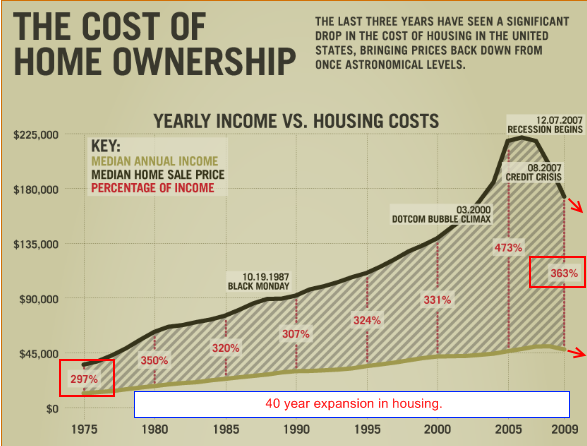
I have been following the housing bubble crisis for years, and I have long believed that housing prices are overpriced relative to Americans' incomes. I still think housing prices are too high and that they will continue to decrease. The My Budget 360 blog has a great article showing that housing prices are still high relative to people's income. I wonder, how will a nation of student loan-indebted people who work low-wage service jobs be able to afford all of those houses valued at over $150,000?

The Economic Collapse blog's article needs to add a thirteenth reason for a continued plunge. As Baby Boomers age they will start selling their houses, adding houses to the market, in the hopes of downsizing to smaller condos and eventually to nursing homes (and ultimately to cemetery plots). However, a great many people in the generations behind them who didn't do as well financially don't have the income needed to purchase all of these houses at current prices. (The people who have the money will be leaving the market.)

Call for Article Links Related to the Education Arms Race

I am in the process of putting together a list of links to articles and other resources related to the Education Arms Race and the legal job market. My goal is to create a resource where people can find links to the evidence--news articles and documentaries, etc.--that higher education is often a scam.

If you know of some good articles, videos, or studies that I am missing, please send me an email or post a comment with the link.

Wednesday, May 26, 2010

Is the Recovery Real? 25 Questions.

If you think that the U.S. economy is recovering, think again. Check out this list of 25 Questions To Ask Anyone Who Is Delusional Enough To Believe That This Economic Recovery Is Real which was posted at The Economic Collapse blog. The author's compilation of the many problems our nation's economy has is very sobering when you see it all in one place.

Saturday, May 22, 2010

Excellent Frontline Program About the Effects of the Recession on New York's Upper East Side

I just finished watching the PBS Frontline documentary Close To Home. I never thought I would have an interest in watching a documentary filmed in a hair salon, but the documentary consisted of interviews with patrons at a (seemingly) upscale hair salon describing how the recession and job loss has affected them.

It isn't a profound documentary, but I think it has value in that it helps to chronicle the depression and give people a sense of its depth. Most of the people interviewed had years of experience and college educations. It thus helps serve as anecdotal evidence that, contrary to what many smug free market dogmatists who downplay the recession believe, hard-working experienced college-educated people who are seeking employment can suffer great difficulty finding employment commensurate with their education, experience, and abilities through no real fault of their own.

I enjoy debating politics on various forums and I often end up in protracted debates with people who are employed and successful. They often have difficulty believing that global labor arbitrage is bad for Americans and that it's hard to find a job. Many of these free market advocates seem to maintain the delusional belief that the unemployed are turning down jobs and mooching government benefits. (To hear them tell it, "We wouldn't have so many unemployed people if only those lazy sots would get off the dole and start working all of those jobs that are out there!") They also argue that global labor arbitrage is good for us but can never provide an intuitively convincing argument addressing the supply-and-demand of labor aspects of it. (I'll discuss this further in a long primer I am preparing about global labor arbitrage.)

I'm sure that the message of this documentary will probably fall on deaf ears in regards to the free market dogmatists, but it is still good to have a documentary anecdotal that provides evidence to hopefully rattle their confidence in their position and weaken their resolve. Perhaps it will also help laid-off free market advocates question their economic belief system. (Long-term unemployment and underemployment can go a long way towards changing a person's world view.)

NPR Aired a Ho-hum Story About Georgetown Law Grads Having Difficulty Finding Jobs.

NPR produced a rather mediocre story about the difficulties Georgetown Law School 3Ls are having with finding jobs in the legal profession. I think it aired Friday afternoon on All Things Considered. You can read a transcript and listen to the program here:

Economy Seems Bleak For Graduating Law Students

Of course, I left a number of comments at the NPR site along with links to a few other blogs and articles. It would be awesome if NPR actually did an in-depth story about the law schools reporting misleading employment statistics with the tacit approval of the ABA knowing fully-well that a great many if not most of their graduates would never find work in the legal profession and that they were impoverishing these students for their own pecuniary interests. I really wish we could educate the general public about the huge conflicts of interest that exist between universities, students, and society. I wish I could convince the public that colleges and universities are just as unethical, socially irresponsible, and self-interested as large for-profit corporations.

Here is a response someone posted to one of my comments:

John Johnson (JJ555) wrote:

Anonymous Frank, you wrote:

"NPR--if you would like to do a serious story about lawyer overproduction and whether or not law schools are providing misleading employment stats..."

Don't waste your time. I mentioned all of that during the discussion with my four co-panelists. It was all removed (or cut, or censored, however you want to say it) from the final piece.

It's actually rather surreal.
I don't know what NPR is like in other cities, but in my area NPR airs "support for NPR" ads from law schools, including one from Boston University (which airs nationally, I assume). Perhaps NPR doesn't want to risk angering its supporters. I suppose that that is a sensible policy, but it calls into question the network's journalistic independence.

Monday, May 17, 2010

Excellent 60 Minutes Report on the Causes of the Gulf Oil Spill (you can watch it online).

60 Minutes has produced an excellent report about the cause of the explosion aboard the Deepwater Horizon oil rig and the subsequent oil spill in the Gulf. The report also includes a discussion and speculation about who exactly is responsible. (This is going to be a boon for lawyers.) The report is more worthwhile and informative than all of the national nightly news broadcasts combined. The heart of the report consists of a riveting interview with a crewman who was lucky to have survived and who remembers details about what led up to the failure of the blowout protector and the explosion. If you enjoy keeping up with current events and issues of legal liability you won't want to miss this. (I find the companies' maneuverings to attempt to shift liability rather entertaining.)

EDIT -- Click here for Part 2
or look for it on the page of Part 1.

Saturday, May 15, 2010

Is Our Oil-Based Economy Absurd?

I got a kick out of one of Mark Fiore's recent animated political cartoons.  Enjoy.

EDIT--here is another oil-related cartoon that I enjoyed. I don't necessarily agree with all of these messages; I just find these political cartoons to be amusing.

Friday, May 14, 2010

Does State Spending on Higher Education Slow Economic Growth?

While reading this Associated Press report (pointed out to me by the But I Did Everything Right blog), I came across the following profound material:

Ohio University economics professor Richard Vedder [author of Going Broke by Degree: Why College Costs Too Much] blames the cultural notion of "credential inflation" for the stream of unqualified students into four-year colleges. His research has found that the number of new jobs requiring college degrees is less than number of college graduates.

Vedder's work also yielded something surprising: The more money states spend on higher education, the less the economy grows — the reverse of long-held assumptions.
If what Vedder says is true, then his study would be absolutely profound.  It makes intuitive sense that wasting a huge amount of resources on education that does not have economic value for society--educating more people than there are jobs for them in the fields for which they are training--would slow economic growth in some sort of way.  However, that is all just theory and conjecture on my part.  It would be great to have a formal academic study demonstrating this.  It's too bad that it would be drowned out by all of the propaganda from the higher education industry, the media, other pundits, and our politicians.

You can listen to an NPR clip where Vedder is interviewed, here:

Is a College Education Worth the Debt?

Tuesday, May 11, 2010

A Law School is PAYING Students $250 to Post On Its Blog in an Attempt to Encourage Students to Attend (and to take on huge amounts of loan debt).

Do we need any further evidence that the law school industry will stop at almost nothing to increase or maintain law school enrollments?  The Jobless Jurisdoctor posted about this first, but I think it is so damning that it deserves separate mention on this and other blogs.  According to the ABA Journal:

A new student blog at the Michigan State University College of Law may not provide all the answers. However, Kristen Flory, director of the school's marketing and communications department, promoted the idea and apparently sees Spartan bLAWg as a plus factor for persuading applicants about the benefits of attending school there.

About nine of the 18 law students who applied were accepted as bloggers and are now paid $250 to write at least two posts monthly, reports the Associated Press in an article reprinted in New York Lawyer (reg. req.).
If the law schools are willing to pay people to post positive content, proving that they are self-interested and in essence for-profit organizations, then why would they not attempt to manipulate their employment statistics or to at least present them in a misleading or fraudulent light?

I wonder, how do law school deans and administrators sleep at night knowing that their costly educational programs will destroy people's lives for decades?  (They probably sleep very well on fine silken sheets in luxurious 5000 foot mansions.)  Do any of these people have a conscience?

Sunday, May 9, 2010

PBS Frontline Airs Excellent Program on For-Profit Colleges

Earlier this week PBS's excellent Frontline documentary series aired an insightful program on for-profit colleges called College Inc., which you can watch online.  Although this was not about graduate and professional education nor even undergraduate education at legitimate colleges and state universities, it was still very worthwhile.  Rather, this was about education at the for-profit McColleges or College-Marts that have sprung up like dandelions across the land, such as the University of Phoenix, DeVry, ITT, and others.  I found the program to be very interesting because I knew little about these businesses, my never having paid much attention to them.  The New York Times also has an excellent article about for-profit colleges, here, which is worth reading:  The New Poor: In Hard Times, Lured Into Trade School and Debt.

Apparently, the cost of attendance is much greater than what I had ever imagined, perhaps reaching as high as a whopping $500 per credit hour.  (If you need 128 semester credit hours to graduate with a bachelors degree from a legitimate university, then the cost of attending at $500 per credit hour would come out to a whopping $64,000 over four years for a podunk bachelors degree.)  Much of this is funded by non-dischargeable federal student loans, and it sounds as though those loans are the lifeblood of these businesses.  [End the federal student loans (or, in essence, the non-dischargeability in bankruptcy of these loans) and these businesses would probably die.]  So, various types of accreditation that allow these businesses to fund themselves through students' federal student loans are essential.  Guess who is involved with investing in these for-profit colleges?  Wall Street, which is a sure sign that the owners of these for-profit colleges have students' and society's best interests at heart (not).

As with many for-profit businesses, advertising consumes a considerable percentage of some of the schools' budgets.  It was also mentioned that the cost of the contract-based faculty at some of these schools was less than the advertising budget; the percentage of money spent on the educational product is not great.  (I think it was reported that one school only spent around 10% on faculty--the educational product.)  It also looked like some of the schools may have used telemarketers (!!!) to call people (in presumably low-income neighborhoods) in an attempt to sell them on the idea of going to college.  Admissions and finance counselors may have even received commission-based or at least sales performance-based compensation for trying to convince people to go to college.  So, in essence, some of the schools may have been telemarketing federal student loans and convincing people to take out federal loans on a commission-like basis!

The problem?  Many of these people end up being burdened with non-dischargeable student loan debt and degrees that have questionable economic and employment value.  Of course, many will not find jobs in the fields they trained for and won't be any better off than they were before but will have student loans to pay.  The program also reported about a couple lawsuits.  For example, some nursing graduates are suing one of the schools because, although the program was accredited and allowed them to obtain legitimate nursing licenses, their degrees were not credible in the job market and thus did not really allow them to obtain employment as nurses.  They said that their pediatrics internship was held at a day care center.  (On a side note, you have to wonder whether the accreditation has meaning any longer and whether the accrediting body was doing its job properly.)  In another case, students who had entered into a psychology PhD. program allege that they were (fraudulently?) told that the program was accredited when it was merely seeking accreditation, which means that they cannot obtain licenses to practice as psychologists, essentially rendering their podunk PhD's worthless.  I'm under the impression that these students received a hard-sell; they may have been sold on the program by people who were, in essence, salespeople for the college.

So who are these for-profit colleges marketed to?  They seem to be marketed to the lower classes, especially to minorities and people who might be the first member of a family to ever go to college and whose relatives wouldn't know (better) to advise them to attend legitimate, more established colleges and universities.  Also, presumably many of those people would be unable to gain admission to state universities.  It was also mentioned that (far less expensive and "non-profit") community colleges are packed and that now people are having difficulty gaining admission to them, leaving the for-profit mills as their only higher education alternative.

So why are all of these people, non-traditional students whose backgrounds probably would not allow them to gain admission to state universities and perhaps even crowded community colleges, so desperate to go to college?  Because our nation's economy is in the shitter and everyone has been indoctrinated with the notion that the only way to advance economically (or to merely be able to obtain a lower middle class job) is to get a college education.  Presumably, the only jobs they can find otherwise are dead-end poverty-wage jobs, so why not roll the dice on these for-profit colleges?  Since our politicians and economists, in their great wisdom, allowed American manufacturing (as well as knowledge-based) jobs to be sent to India, China, and Mexico, to be filled with foreigners on H-1B and L-1 visas, or (more likely to affect the students attending these for-profit colleges) given to masses of immigrants (both legal and illegal) the students are under tremendous pressure to find knowledge-based employment.
 
The end result is that the job market will be flooded with these McBachelors degrees.  (Traditional state universities and established private colleges were already flooding the market.)  Also the bachelors degree will become the modern equivalent of a high school diploma, except it isn't free.  However, in spite of all of this higher education, knowledge-based, college-education-requiring jobs will not magically materialize into existence to accommodate everyone who has a college degree.  All of the time, money, and resources invested in this unprecedented amount of higher education will change almost nothing about the state of our nation's job market.  It will not create jobs or wealth for anyone other than the owners of the colleges, some administrators, and perhaps some faculty (if they receive decent compensation at all which I highly doubt).  Instead, in reality, it is all just a huge amount of economic waste.  Consequently, our society will be filled with unemployed or underemployed-and-out-of-field people with student loan debt and our nation may gain the distinction of having the most well-educated Walmart employees.

I have been railing against the problems of degree overproduction in graduate and professional education for years.  Prior to a viewing of College, Inc. I was aware of the existence of the for-profit schools, but I was unaware how expensive they were nor that the scope of these operations was so large.  Thus, I highly recommend a viewing of this video.  Hopefully Frontline will one day do a report about the law school and graduate school scams at "non-profit" state universities and private colleges, but I doubt it.

Thursday, May 6, 2010

Only in America...

...would a high school principal send American flag-wearing students home so as not to offend Mexican-American students on Cinco de Mayo.  Being booted out of high school (for a day) for a non-incendiary display of patriotism could only happen in America.  Would principal Boden find a t-shirt with an image of an American flag covered in excrement more appropriate and less offensive?

Blogger Templates by OurBlogTemplates.com 2007